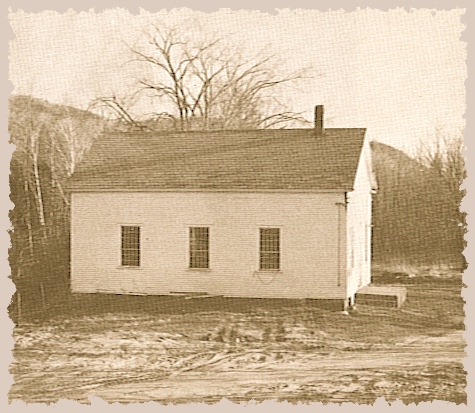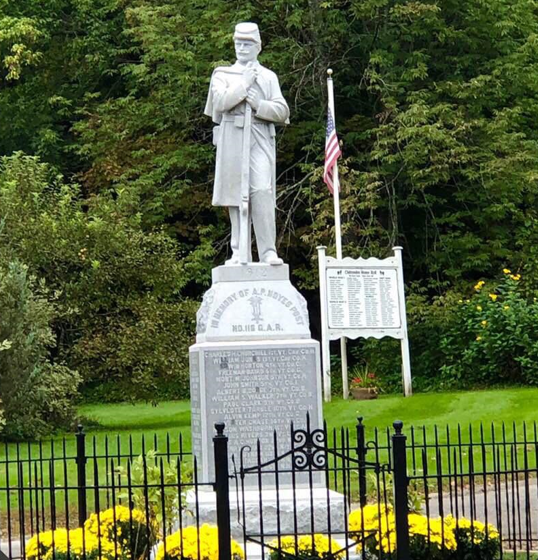


The nine members of the Chittenden Historical Society gathered at the Grange Hall to present their treasures, finds and what-zits for a fun time of sharing and learning.
Bob Muzzy was the unanimous choice to lead off the evening. This was especially poignant because this year is the 50th anniversary of the founding of the Chittenden Historical Society and Bob was the first president. He shared the book, “Vermont Wilderness to Statehood, 1798-1791” written by Warren Dexter and Barbara C. Hanson. Bob then told the story of becoming acquainted with Warren Dexter whom he met when they both served on the Chittenden Bicentennial Committee in 1976. Warren was from Rutland. He was retired, his wife had died then Warren got to know people in Chittenden. There was a fellow (couldn’t remember his name) at Mountain Top who was interested in Chittenden history. Warren started digging around and found log books for Phineas Stevens from the 1700’s. These books described journeys and trails in Vermont and New Hampshire. Warren followed those trails and found the Indian trail that later became the Green Road. The Green Road is now a hiking trail determined through an agreement with the town in 2006 and which was upheld in 2025.
Bob and his family got to know Warren through his research. Warren was enthusiastic in his support that the town start the Chittenden Historical Society. Bob and his wife Gladys are charter members of the then large, active Chittenden Historical Society. The Society looks forward to honoring these founding members this year.
Marcia Lertola has a love of finding old bottles. She brought a milk bottle from the Proctor Creamery. Many longtime residents recalled deliveries from the Proctor Creamery. It seems at that time most local dairies had their own bottling operations and would deliver milk and cream in bottles stacked in wooden or wire crates.
Marcia also had a soda bottle from the Dominion Beverage Company. She had found it in the dirt under a tree next to her place of work in Brandon. Soda had been bottled by Louis Farrell & Company, later Farrell Distributors. Several of the locals chuckled over the find declaring that the spot had been a local hangout when they were teenagers. Sly grins indicated that there might be more than soda bottles there.
David Sargent brought a whatsit that had belonged to his father. This description probably won’t do it justice but it was a gadget to ream and grease fittings for machinery. The first guesses were some sort of drill but Bob Muzzy with his keen interest in old tools knew the answer. Dave confirmed it.
Elaine Meyers brought pictures of a very old and very large Christmas cactus that had belonged to her grandmother. She was tempted to bring the cactus itself but it was just too big. The Christmas cactus had bloomed every year. When her grandmother died family members were allowed to take pieces of it to grow for themselves. It had grown beautifully and Elaine set it out on the porch railing. The neighbor’s dog stole it and apparently gave it to the goat! The goat tore it up but Elaine was able to rescue a couple of pieces and resuscitate it. The cactus still needs to bloom but there are great hopes.
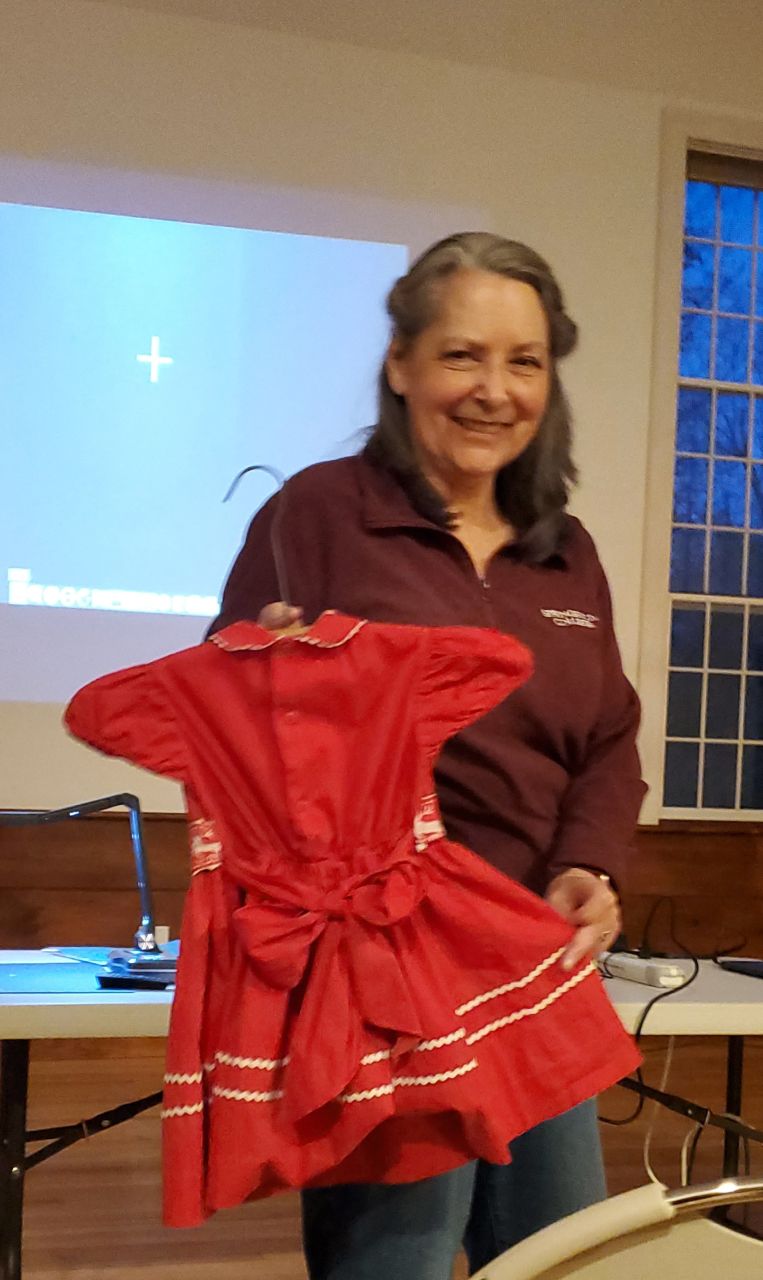
Molly Douglas had brought a very small red dress with reindeer embroidered decorative band on the front, a round collar, short, puffy sleeves and a sash tied in a bow. White rick rack trim was added to the collar and the hem of the gathered skirt. This had been Molly’s dress when she was about five or six years old. She shared that the dress had probably been worn to school daily since she only had about three dresses. Girls were not allowed to wear pants to school. Several of the women nodded in agreement and shared that dressing for winter outdoor play could be a process where the bulky snowpants were pulled up while the skirts were stuffed into the pants then suspenders put over the shoulders. Heavy jackets were worn over that with hand-knitted hats and mittens and rubber galoshes. None of the warm, light-weight fabrics were available then. Elaine observed the slightly worn line on the hem and surmised that the skirt had been shortened then let down as Molly grew taller. Bob Muzzy added that “you grew some since then!”
Martha Welch shared a message against alcohol consumption written and delivered by the Reverend S.M. McLaughlin from the pulpit. According to a quick AI search: Reverend S.M. McLaughlin was a late 19th-century Methodist Episcopal pastor best known for his time leading the church in Rutland, Vermont in the 1890s.
A quick AI search found this information:
- The 1892 Rutland Riot: In July 1892, Rev. McLaughlin preached in favor of law, order, and strict temperance (prohibition of alcohol) during a period of civil unrest. This culminated in riots in Rutland, VT as citizens protested against strict liquor laws.
- Historical Records: His 3-year term serving the region is chronicled in community archives, which note his advocacy against “blind tigers” (illegal speakeasies) and his efforts to clear church debts.
Vermont had Prohibition from 1852 to 1892. There was a bottle from Fred Flynn who was a bootlegger and had the largest cache of liquor. Marcia observed that there is some evidence of a still near her home. Bob said that there were stills all over the place.
Steve Welch had brought two items and challenged everyone to identify them. Most readily identified the rug beater but were puzzled about the second. Several said that rug beaters could come in all different sizes and could be quite ornate. Steve finally ended the puzzlement about the second item. It was a laundry lifter used when the laundry used to be done in a large kettle in the back yard. The lifter was used to lift the hot, wet laundry from the kettle to hang on the clothesline. Both items had belonged to and been used by his grandmother.
Members had refreshments, took closer looks at the items and had discussions about them before ending the happy evening.